When you outgrow selective pallet rack, the next step is high-density storage. Drive-in and push-back racking are the two most common ways to get there. Both store more pallets per square foot than selective rack. Both reduce aisle space. And both have very different operating models that make one a much better fit than the other depending on what you are storing.
Picking the wrong one is expensive. We have walked into warehouses with brand new drive-in rack that should have been push-back, and vice versa. Once it is installed and anchored, switching is a full demolition and reinstall.
How Drive-In Racking Works
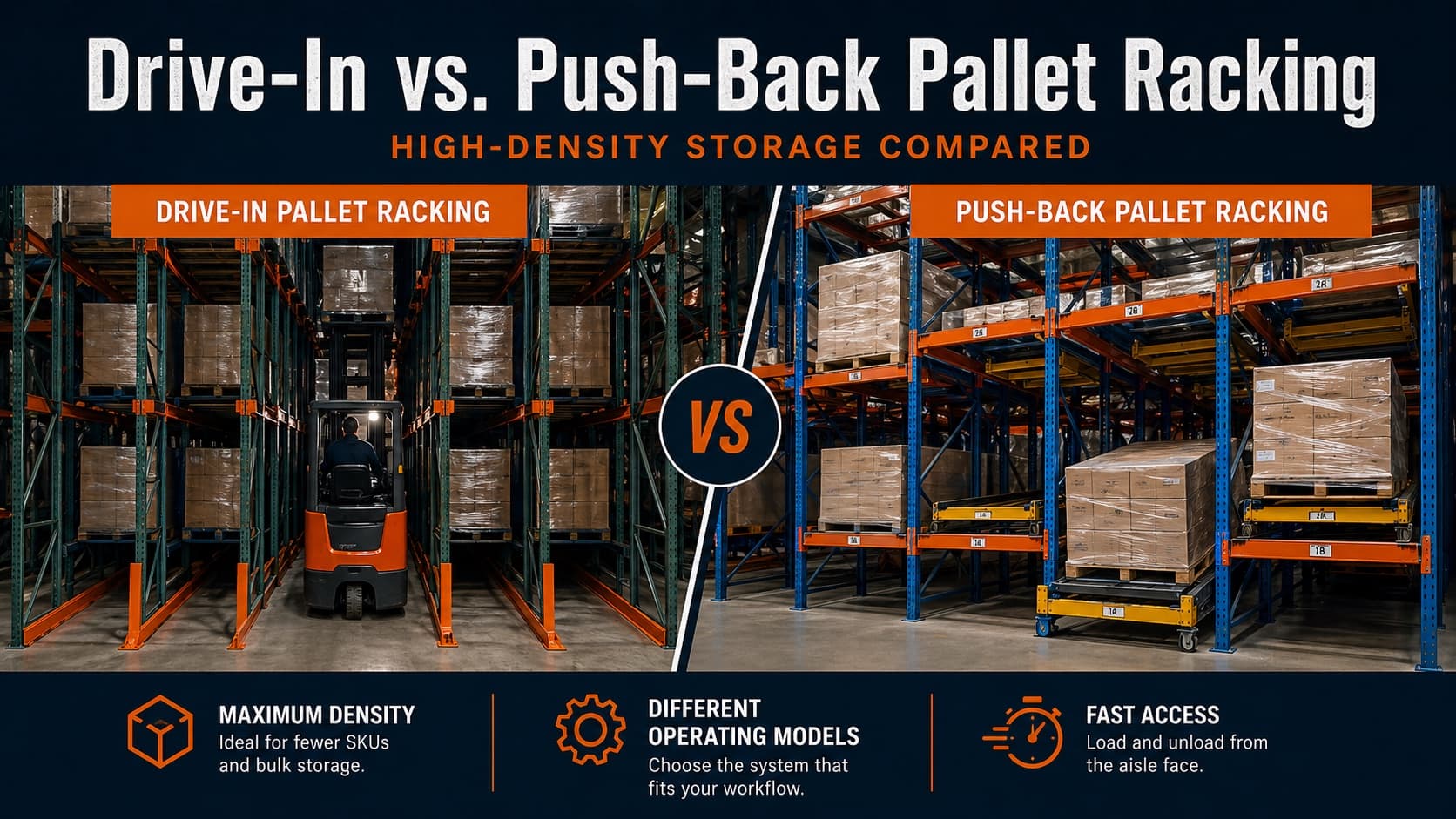
Drive-in racking has rails that run horizontally into a deep storage lane. The forklift literally drives into the lane, drops the pallet on the rails, and backs out. Pallets are stored on the rails, not on cross beams.
Drive-in is LIFO (last in, first out). The first pallet you load is the last one you can retrieve, because everything stored after it is in the way. This makes drive-in best for products where every pallet in the lane is the same SKU and rotation between pallets does not matter.
How Push-Back Racking Works
Push-back rack uses a series of nested carts on inclined rails. When you load a pallet onto the front, it pushes the pallets behind it back one cart position. When you remove the front pallet, the next one rolls forward into the pick position by gravity.
Push-back is LIFO like drive-in, but the operator never drives into the rack. They load and unload from the aisle face, exactly like selective rack. That is the key advantage: faster cycle times, less rack damage, and a much shorter learning curve for forklift operators.
Storage Density Compared
Drive-in rack typically stores 5 to 10 pallets deep per lane. Push-back is usually 2 to 6 pallets deep. So drive-in wins on raw density, especially in deep cold storage applications where every cubic foot counts.
But density on paper does not always translate to usable storage. Drive-in lanes have to be dedicated to a single SKU or you lose access. If your SKU mix is too varied, you end up with half-empty lanes and your real storage density drops below selective rack.
When to Choose Drive-In
Drive-in is the right choice when:
- You have a small number of SKUs with high pallet count per SKU. Cold storage, beverage distribution, and bulk commodity warehousing are classic drive-in applications.
- You can dedicate full lanes to single SKUs without wasted space.
- Pallet rotation between identical pallets does not matter.
- Storage density is more important than pick speed.
When to Choose Push-Back
Push-back is the right choice when:
- You have more SKUs than drive-in can handle without lane sharing.
- You need faster cycle times than drive-in allows.
- You want to reduce rack damage. Drive-in lanes get hit constantly because forklifts drive into them.
- Your operators are not specifically trained on drive-in technique.
- Lane depths of 2 to 6 pallets are sufficient for your volume.
Cost Differences
Drive-in rack is less expensive per pallet position than push-back because it has fewer moving parts. There are no carts, no rails on inclines, no nested mechanisms. Just uprights and rails.
Push-back is more expensive because of the cart system, but the operating cost is lower. Less rack damage, less forklift wear, faster cycle times. On a 5-year total cost of ownership basis, push-back often wins for warehouses with active SKU rotation.
Fire Code and High-Pile Storage
Both drive-in and push-back fall under high-pile storage rules in Clark County once you exceed the height threshold (12 feet for most commodities, 6 feet for Group A plastics and similar). Both systems also affect sprinkler design.
Drive-in rack creates flue space challenges that fire marshals scrutinize closely. The deep lanes can restrict water penetration from ceiling sprinklers, which sometimes drives a requirement for in-rack sprinklers. Push-back is a little more forgiving on flue spaces because the cart system maintains some vertical clearance.
Source 4 and High-Density Rack Systems
We design and install both drive-in and push-back rack systems across Las Vegas, Henderson, and North Las Vegas. We do the SKU analysis, lane depth math, and fire code review before we quote, so you do not end up with a system that looks great on paper but fails in production.
If you are weighing drive-in vs. push-back for your warehouse, call us at (702) 291-9520. Bring your SKU count, pallets per SKU, and turn rate. We will walk you through which system makes sense and why.